
|
Western Australian Dragon
Search Project:
Preliminary Bioregional
Summary of Sighting Data
January 1998 - December
2000
by Janine Baker
Distribution
(i) Total Sightings: To August 2000, 359 sightings have been recorded in Western Australian waters by the Dragon Search Program and related records, including 11 sightings in which both leafies and weedies were recorded together. To date, 757 seadragons have been recorded, including an unknown number of repeat sightings of the same animals. Around 44% of sightings, and 57% of the total number of seadragons sighted, have come from locations in the WA South Coast Bioregion; 50% of sightings (40% of seadragons) have been recorded from the Leeuwin - Naturaliste Bioregion, and 4% of sightings (2% of seadragons) have come from the Central West Coast. Two sightings have been recorded from the offshore Abrolhos Islands Bioregion. Three unconfirmed sightings have been recorded in more northerly parts of W.A. (e.g. Shark Bay and Onslow).Note that relative abundance of seadragons at each location cannot be determined, due to the non-systematic nature of Dragon Search sightings, which are influenced by diver preference regarding choice of dive site; accessibility of dive site; possible higher promotion and diver recognition of Dragon Search in metropolitan and other popular diving locations compared with more remote areas, and other factors. Similarly, it is not possible to determine the proportion of sightings per location that are repeat sightings of the same animals or groups of animals. However, as indicated in the tables below, the area from Albany to Esperance appears to be important for both species of seadragon. As described in the sections below, the majority of sightings in the southern part of WA have come from the reefs and seagrass beds associated with the bays, sounds and headlands in the Albany - Esperance area. It is noteworthy that one of only 2 records in this database of large aggregations (purportedly around 100 animals, in this case), was reported by a fisher in the Albany area. It is noted, however, that the preponderance of records from Bremer Bay is perhaps more indicative of regular reporting (from repeated diving) at that particular site, than of higher seadragon abundance relative to other areas. In the metropolitan coastal region, the bulk of sightings of both species has come from locations around Perth, Fremantle and Rottnest Island. Although this may reflect the accessibility of these areas, it is interesting to note the importance of local, developed (and in some cases, polluted) areas as habitat for these species.(ii) Weedies: To August 2000, approximately 240 sightings of weedies, (representing 454 animals, including repeat sightings) have been recorded, or 250 sightings if the records in which both leafies and weedies occurring together are included. Of these records, 48% have come from locations in the Leeuwin - Naturaliste Bioregion; 48% also from the WA South Coast Bioregion, and 3% from Central West Coast Bioregion.
(iii) Leafies: To date, around 105 sightings of leafies have been reported, representing 303 animals, including repeat sightings, or 115 sightings, if the records if which both leafies and weedies occurring together are included. More than half (54%) of the leafy sightings have been recorded in the Leeuwin - Naturaliste Bioregion; 37% from the WA South Coast Bioregion, and 7% from the Central West Coast.
Figure 1a & 1b summarise the statewide distribution of seadragon
sightings, to September 2000.
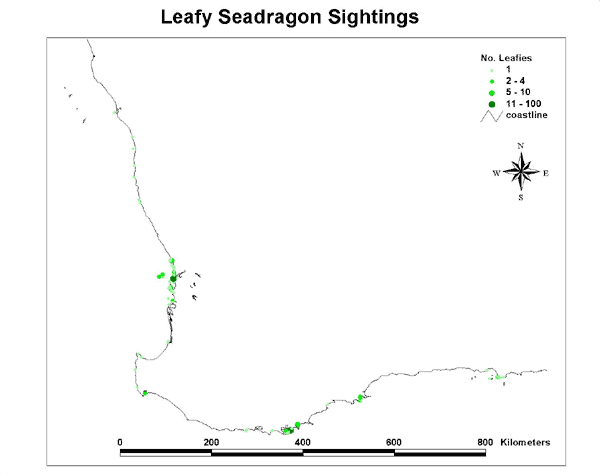
Figure 1a summarises
the statewide distribution of leafy seadragon sightings, to September 2000.
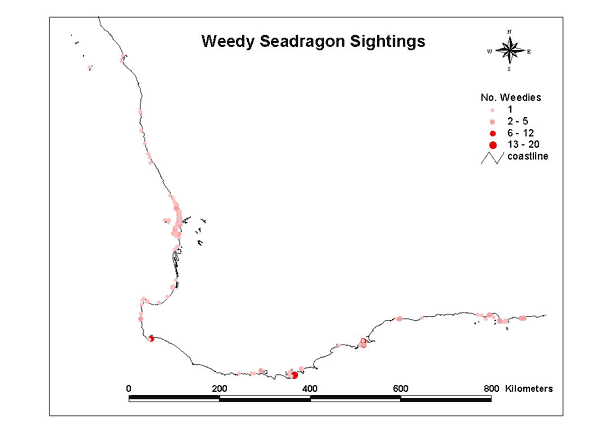
Figure 1b summarises
the statewide distribution of weedy seadragon sightings, to September 2000.
The tables below summarise the main locations within each bioregion,
where divers have sighted seadragons (including repeat sightings at the
same location). Figure 2 also summarises the bioregional distribution of
seadragon sightings.
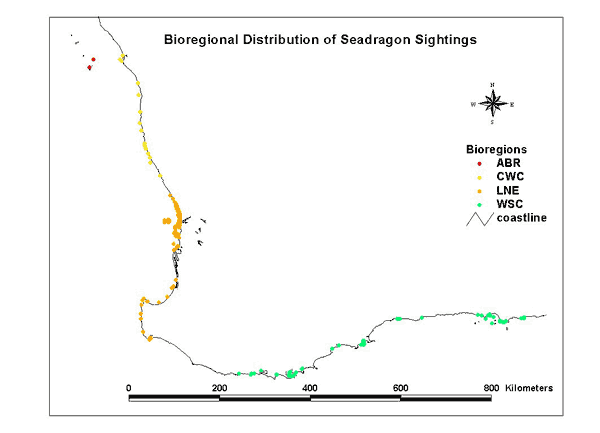
Figure 2 Bioregional
Distribution of Seadragon Sightings
(i) Western Australian South Coast (WSC) Bioregion
|
|
|
|
| • Cape le Grande National Park (e.g. Lucky Bay, Thistle Cove)
• Duke of Orleans Bay • Esperance Bay • Tanker Jetty |
|
|
| • Outer Reef
• Two Mile Reef • Powell Point |
|
|
| • Back Beach
• Little Boat Harbour • Short Beach • Fishery Beach |
|
|
| • King George Sound
• Frenchmans Bay • Two Peoples Bay • Mistaken Island • 'Whaleworld' |
|
|
| • William Bay |
|
|
In the Western Australian South Coast Bioregion, 60% of weedy sightings
have come from Bremer Bay (and of those sightings, 41% have been recorded
in the Back Beach area, and 28% from Little Boat Harbour); 18% of weedy
sightings have come from the Esperance area, and 14% from Albany.
A single sighting has come from Walpole.
|
|
|
|
| • Cape le Grande National Park (Lucky Bay)
• Tanker Jetty |
|
|
| • Fish Eyes
• Little Boat Harbour • Black Point • Back Beach |
|
|
| • Frenchmans Bay
• Two Peoples Bay • Michelmas Reef |
|
|
| • Cosy Corner Beach |
|
|
| • William Bay |
|
|
In the WSC Bioregion, the number of leafy sightings to date has been
less than half than the number of weedy sightings, and 53% of those leafy
sightings have come from Bremer Bay, a South Coast tourist destination
where regular reportings from Dragon Search divers have been made. The
other major locations in which South Coast leafies have been recorded are
Esperance (18% of sightings) and Albany (15% of leafy sightings).
There has been a single sighting from Cape Riche.
(ii) Leeuwin - Naturaliste Bioregion
|
|
|
|
| • Cottesloe
• Hillary’s Boat Harbour • Carnac Island • Marmion Marine Park • City Beach • Ocean Reef |
|
|
| • Geordie Bay |
|
|
| • North Mole
• South Mole |
|
|
|
|
|
|
| • Warnbro
• Cape Peron |
|
|
|
|
|
|
|
|
|
|
|
|
|
|
| • Busselton Jetty |
|
|
|
|
|
|
| • Bunker Bay |
|
|
Around one third of the weedy sightings in the Leeuwin - Naturaliste Bioregion have come from the Perth area, with the largest number of those sightings recorded in the Cottesloe area, and at Hillary’s Boat Harbour. There have been several sightings from Carnac Island, Marmion Marine Park, City Beach and Ocean Reef, and two sightings each from Mindarie, Scarborough, and Sorrento. Single sightings have been recorded from Trigg, Mettams Pool, “Underwater World”, and several other locations. There has been one weedy sighting from the Swan River.
Apart from Geordie Bay, weedy sightings from Rottnest Island have come
from North Point, Parker Point, Little Armstrong Bay, Horseshoe Reef and
Bathurst Point. The majority of sightings from the Fremantle area have
come from North Mole (14 records). The table above lists other sighting
locations in the Leeuwin - Naturaliste Bioregion, in which 3 or more sightings
have been recorded. One or two sightings have been recorded at Two Rocks,
Yanchep, Waikiki, Binningup, Stratham, Dunsborough, Yallingup, Gracetown,
Margaret River, Cape Leeuwin and several other locations.
|
|
|
|
| • Marmion Marine Park
• Hillary’s Boat Harbour • Cottesloe • Carnac Island • Burns Beach |
|
|
| • Little Parakeet Bay
• Grouper Caves |
|
|
| • North Mole |
|
|
|
|
|
|
| • Cape Peron |
|
|
| • Bunker Bay |
|
|
|
|
|
In the Leeuwin - Naturaliste Bioregion, the number of leafy sightings
to date has been approximately half the number of weedy sightings, and
approximately 28% of those sightings have come from the Perth area, and
around 23% from Rottnest Island. Apart from the locations specified in
the table above, Perth metropolitan locations at which leafies have been
recorded include Woodman Point, North Beach, Little Island, Floreat Beach
and City Beach, and several other locations. On Rottnest Island, 4 records
of leafies came from Little Parakeet Bay and Grouper Caves, with single
sightings from a number of other locations around the island (Salmon Point,
West Point, Parker Point, Roe Reef, Porpoise Bay, Nancy Cove, Fay’s Bay,
Duck Rock, and Monday Rock). Around Fremantle, leafies have been recorded
from North Mole, Catherine Point, and the jetty near the Maritime Museum.
Two leafy sightings have been reported from Bunbury, and in the Margaret
River region, single sightings have been recorded at Dunsborough, Gracetown
Bay, Hamelin Bay, and Augusta.
(iii) Central West Coast Bioregion
To date, only 8 records of leafy seadragons and 8 records of weedies
have been reported from the Central West Coast Bioregion. Only one of these
records (from Geraldton) was a diving record; all others were beachcomber
records (6 sightings of leafies and 7 sightings of weedies), or sightings
by other means. Central West Coast locations in which weedies have
been recorded include Cervantes, Geraldton, Jurien Bay and Illawong. CWC
locations in which leafies have been recorded include Geraldton, Cervantes,
Illawong and Port Denison.
Sighting Details
(i) Seasonal Summary of Sightings: Figure 3 below shows
a monthly summary of seadragon sightings to September 2000. Around one
third of sightings were made during the summer months. To date, 44% of
weedy seadragon sightings have been made in summer, 25% in autumn, 10%
in winter and 21% in spring. For leafies, 51% of leafy seadragon sightings
have been made in summer, 26% in autumn, 7% in winter and 16% in spring.
Neither relative frequency nor abundance of seadragons per sighting location
can be meaningfully discussed on a seasonal basis due to the non-standardised
nature of the recording, which is affected by a number of factors. These
include (i) uneven distribution of recordings over space and time; (ii)
individual preferences in the locations and seasons (e.g. summer) in which
recorders chose to dive or beach-walk, (iii) weather and/or sea conditions,
and (iv) other opportunistic and/or uncontrollable aspects of the recordings.
However, monthly distribution of seadragon sightings provides important
supporting information when assessing seasonality of breeding, as discussed
in the section below on Brooding Male Seadragons.
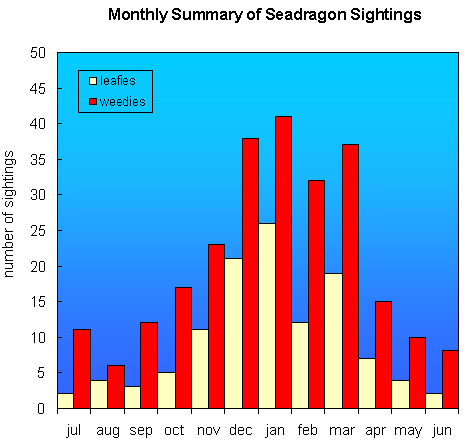
Figure 3 Monthly Summary of Seadragon Sightings to September 2000
(ii) Summary of Sighting Modes: To date, around 60% of
weedy seadragon sightings have been recorded by SCUBA divers (= 64% of
total number of seadragons sighted, representing 290 weedies sighted by
SCUBA divers, including repeat sightings); 28% have been records of dead
weedies sighted by beachcombers (20% of the total number of seadragons
sighted, representing 91 seadragons); 10% of sightings have been recorded
during snorkelling (25 records; 43 seadragons), and 2% of weedy sightings
have been due to other means (e.g. during trawling/netting etc).
Similar to weedies, 60% of leafy sightings were made by SCUBA divers, (=
46% of total number of seadragons sighted, representing a total of 140
leafies, including repeat sightings). To date, beachcombers recorded 20%
of leafy sightings (representing 24 animals, or 8% of total number of leafies
sighted); 15% of leafy sightings have been recorded during snorkelling
(32 animals, or 10% of total number of leafies sighted), and 5% of sightings
occurred due to other means, such as accidentally capturing seadragons
during netting, or recording a seadragon aggregation whilst fishing in
the adjacent area. Sightings of leafies by other means represents approximately
109 leafies, or 36% of the number of leafies sighted to date.
The 10 records of Sightings by Other Means are of interest, because
they include the following:
(i) A large aggregation of leafies (approximately
100 animals) observed by a night fisher at Albany, in the winter of 1998;
(ii) 20 weedies (including an unknown number
of brooding males) and 36 western seahorses caught in a pilchard purse
seine net (and released alive), at a reef sight in King George Sound, Albany,
in the winter of 1998;
(iii) 4 brooding weedies and 4 leafies caught alive
in a purse seine net in the City Beach (Perth) area, in January 1989;
(iv) 4 seadragons (2 weedies and 2 leafies) and
an unknown number of seahorses, caught in a net (and released alive), from
fishing activity in the shallow waters at Fremantle, in September 1998;
(v) 1 leafy adult, caught alive in a cray pot, at
Port Denison, in November 1998;
(vi) 3 animals (1 weedy adult, 1 weedy juvenile,
1 leafy juvenile) in a drifting patch of seaweed, caught during prawn trawling
on sandy substrate at Garden Bank, in June 1985.
Habitat Preference
To date, habitat type has been specified for 92% of all sightings by
the applicable modes (SCUBA, snorkelling, other means). Although
there appears to be some lack of standardisation in the recording of habitat
details, notable results to date include:
• the high incidence of weedy seadragon sightings
both over seagrass habitat (30%); and macroalgal (seaweed)-dominated
habitat (37%);
• more than twice the number of records (48%) of
leafy seadragon sightings over macroalgal-dominated habitat, compared with
seagrass habitat (19%). However, this cannot be used as evidence for habitat
preference due to the opportunistic and non-standardised nature of the
Dragon Search recordings, and the fact that the comparatively large number
of records from specific locations favoured by Dragon Search reporters
(e.g. Bremer Bay and the metropolitan areas around Perth), can bias statewide
summary results of habitat data;
• 13% of weedy sightings and 12% of leafy sightings
recorded from mixed habitat (seagrass and seaweed/reef), described
below;
• 4% of weedy sightings and 7% of leafy sightings
recorded from reef that (presumably) is not dominated by macroalgae;
• the low incidence of sightings (2% of weedy sightings,
and 0 leafy sightings) over bare sand habitat: apart from the fact
that bare sand habitats are of less interest to divers, and thus fewer
records come from such areas irrespective of other factors, low incidence
of sightings over sand probably reflects lack of food availability over
bare substrate, and/or seadragons' habitat preference for vegetation as
a means of camouflage.
“Mixed” habitat types that have been recorded in the Dragon Search database include seagrass beds (e.g. Posidonia) adjacent to kelp beds; seagrass meadows interspersed with patch limestone reefs; limestone reef with patchy seagrass in the vicinity; mixed granite reef and seagrass bed habitat; and seagrass adjacent to either “reef walls” or rock groynes.
Habitat types recorded as “other” (4% of weedy sightings and
7% of leafy sightings) include jetty pylons on sand; “sponge wall”; bare
sand with limestone patches; “coral”; “rock with coral”, and several records
of sand beds or sand “gullies” adjacent to rocky reefs/crevices. Habitat
type was not specified for 9% of weedy sightings and 7% of leafy sightings.
Behaviour
To date, behaviour has been recorded for 411 weedy and 194 leafy seadragons,
including repeat sightings. The table below summarises the main behaviours
observed for individuals and groups of both species. For weedies, the 20%
recorded as “defending” included, but was not limited to, brood males.
There have been 2 records of weedies courting, and 2 records of weedies
“nursing”, but it is assumed that only one of those latter two records
refers to a weedy with young juveniles, since the other record was of a
brood male without young. To date, there have been 24 records of feeding
behaviour. Both leafies and weedies have been observed feeding in both
seagrass and seaweed-dominated habitat, and also amongst jetty pylons.
“Defending” and “drifting” are other recorded behaviours observed during
feeding. There was no recording of behaviour for 10% of weedy seadragons
and 36% of leafy seadragons sighted.
|
|
|
|
|
|
|
|
|
|
|
|
|
|
|
|
|
|
|
|
|
|
|
|
Seadragon Groups
To date, 64% of weedy sightings and 80% of leafy sightings recorded
by divers or snorkellers have been of single animals. However, groups of
weedies have been recorded at a number of locations in both the WSC and
LNE Bioregions. The table below summarises the locations of records of
weedy group sightings, from 3 to 12 animals. It is possible that some of
these records represent repeat sightings of the same group. For example,
amongst other similar examples, there are:
• 3 records of a sighting of group of 5 seadragons,
sighted on the same day in March 1999, in Bremer Bay;
• 2 records of a group of 3 seadragons sighted
3 days apart, at North Mole, Fremantle; and
• 2 records of a group of 3 seadragons sighted within
10 days, at Cape le Grand National Park near Esperance, in December 1998.
In another case, it is difficult to determine whether two separate
records from the same location (Bremer Bay), on the same day (13 November
1999), in which are recorded different numbers of weedies per group (e.g.
5; 10) refer to different groups, or the same loosely structured group.
Group sightings of both adults and juveniles have been recorded in Bremer
Bay (e.g. 4 juveniles; 12 adults, sighted on separate occasions within
a 6-week period in autumn 2000)
To date, 22 records of pairs of weedy seadragons have been reported,
mainly from Bremer Bay, but other areas include Esperance, Bunbury, Perth
(Hillary’s Boat Harbour, Cottesloe, Mindarie, Ocean Reef Marina), Fremantle
and Garden Island.
|
per Group (including repeat sightings) |
|
|
|
|
|
|
|
|
|
|
|
|
Little Boat Harbour; Back Beach Palm Beach North Mole |
Bremer Bay (8 records) Rockingham Fremantle |
|
|
|
|
|
|
Little Boat Harbour (2 records) Frenchmans Bay North Mole (4 records); South Mole Off Beagle Rd |
Bremer Bay Albany Fremantle Garden Island |
Few sightings of leafy groups have been recorded. One notable record
comes from Fremantle, where approximately 50 juvenile leafies were sighted
by a SCUBA diver in April 1988. Summaries of leafy groups appear in the
table below. To date, 12 records of pairs of leafy seadragons have
been reported, from Esperance, Bremer Bay and Albany in the WA South Coast
Bioregion, and from Perth (Cottesloe), Rottnest Island, Fremantle and Mandurah
in the Lleuwin - Naturaliste Bioregion. There has been one unconfirmed
record of a pair of leafies from Roebuck Bay, Broome.
|
per Group (including repeat sightings) |
|
|
|
|
|
|
|
|
|
|
|
|
|
|
Brooding Male Seadragons
Figure 4 below summarises the number of sightings reported to date,
of brooding male weedies and leafies, over the entire state.
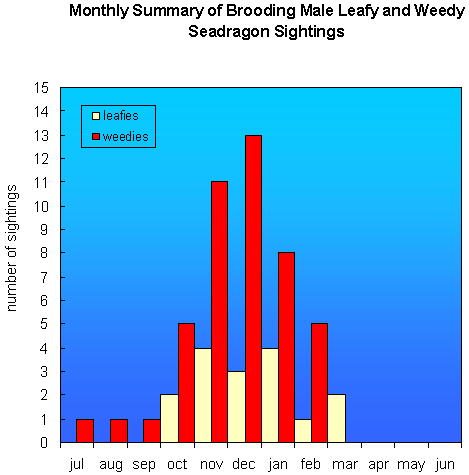
Figure 4: Monthly
Summary of Brooding Male Leafy and Weedy Seadragon Sightings
(N.B. Locations and Years
Combined)
(i) Statewide Records: To date, brooding male weedy seadragons have been sighted between mid winter and the end of summer (Figure 4), and brooding male leafies have been sighted between mid spring to early autumn. At a statewide level, with data pooled for all years, 45 individual sightings of brooding weedy males (representing 67 animals) and 16 sightings of brooding leafy males (representing 17 animals) were made. To date, 94% of the brooding male weedy sightings have been recorded between mid spring (October) to late summer (February). Interestingly, there are 3 records of breeding male weedies observed during winter and early spring, in 1998 and 1999. No sightings of brooding male weedies were made during dives from March to June. The conjecture that brooding does not occur during autumn to early winter is supported by the fact that 28% of all weedy seadragon sightings occurred during March to June, but no breeding males were observed during sightings in those months. For leafies, 19% of all sightings were recorded between (and including) the months of April and September, but no brooding males were observed during that time. Due to the relatively small number of leafy seadragon records available, amongst other factors, it cannot be inferred that breeding is restricted to the spring-summer period between October and March. However, despite the non-systematic nature of the data, and the smaller number of leafy records compared with weedies, records from Dragon Search appear to support other available evidence that spring and summer are the main periods in which seadragon species in Western Australia breed.
At a statewide scale, brooding male weedies have been recorded at depths ranging from 2m to 22m (N.B. excluding one pilchard purse seining by-catch record from 28m), and brooding male leafies have been recorded from 3m to 14m. Little can be inferred about differences between species in recorded depth range due to the fact that seadragons were not searched for at all depths within a specified range (i.e. the recordings are opportunistic, not systematic).
(ii) Bioregional Records: In the southern bioregion (WA
South Coast), brooding male weedy seadragons have been observed from mid
winter (July) through to late summer (February), representing a total of
37 records. More than half (54%) of those records refer to brooding male
weedies observed during late spring to early summer (November - December),
and 84% refer to recordings during the mid spring (October) to mid summer
(January) period. To date, 2 of the records for the WSC Bioregion refer
to brooding males observed during winter (July, from King George Sound
near Albany) and early spring (September, from Bremer Bay).
In the Lleuwin - Naturaliste Bioregion, a small number of records of
breeding male weedies have been reported (8 records), over a 12 year period
(1988 to 1999). Therefore, seasonal data for that bioregion will not be
discussed, other than to note the single record of a brooding weedy male
observed in August (metropolitan Perth area).
For leafies, 13 records of brooding leafy males have been reported
to date from the WSC Bioregion during the past 3 years (1998 to 2000),
all of those records referring to sightings of single brooding males observed
between October and March. For brooding leafy males, the majority of records
in the WSC Bioregion have come from Bremer Bay (10 records), although there
are also two records from Albany and one from Torbay. All of those records
have been of a single leafy male. In the LNE Bioregion, there are very
few records of brooding male leafies in the database (3 records, to date),
those 3 records having been reported from Fremantle, Mandurah (single sighting
of 2 brooding animals) and Bunbury.
(iii) Groups of Brooding Males: Groups of male weedy seadragons with eggs have been observed by SCUBA divers and snorkellers during the past 3 years (1998 to 2000) in the Albany to Esperance area, including Bremer Bay, Two Peoples Bay and Lucky Bay. To date, there are 9 records of such groups, the largest group sightings being of 6 males (observed in November 1999 in Bremer Bay) and 5 males (observed in December 1999 in Lucky Bay, near Esperance).
Figure 5 summarises the distribution of sightings of brood male seadragons,
to September 2000.
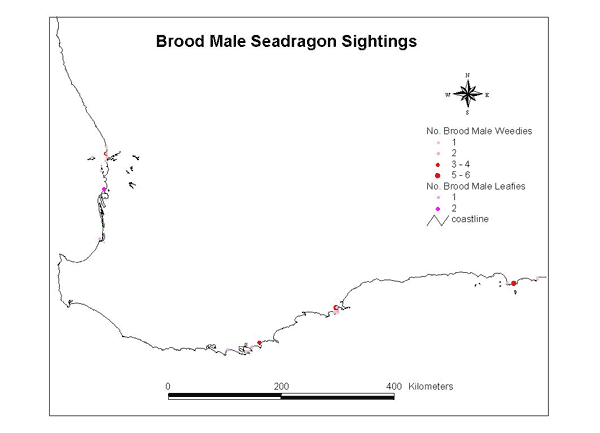
Figure 5 Distribution
of brood male seadragon sightings, to September 2000
Juvenile Seadragons
Juvenile weedies have apparently been observed during all months of
the year, and there appears to be no seasonal pattern in observations,
due to the small number of records (N = 30 for the whole state, with years
and locations combined), amongst other factors described below. The largest
number of monthly records include June (5 records), and September, December,
February and March (4 records for each month). To date, only 18 records
of juvenile leafies have been reported, with the largest number for the
month of January (6 records).
The tables below summarise the locations at which groups of juvenile
seadragons, and groups of adult and juvenile seadragons, have been observed.
|
|
|
|
|
|
4 |
0 (2 records) |
|
|
|
|
|
Bremer Bay Perth |
2 2 |
0 0 |
|
Bremer Bay Bremer Bay Perth Garden Island Bremer Bay |
1 1 1 1 1 |
7 2 1 1 1 (4 records) |
|
|
|
|
|
|
|
|
|
|
|
|
|
|
|
|
|
|
|
|
Small groups of juvenile weedies, both with and without adults, have been recorded on several occasions at Bremer Bay dive sites. Also of interest is a pre-Dragon search sighting (April 1988) of 50 juvenile leafies, purportedly clustered within a 40 square metre area, around the Maritime Museum jetty at Fremantle. Single juvenile weedy seadragons (i.e. without adults) have apparently been observed in the Perth area; Fremantle; Augusta; Bremer Bay and Albany. Single leafy seadragons have been observed at locations in the Perth metropolitan area; Rottnest Island; Fremantle; Garden Island; Gracetown Bay; Bremer Bay and Esperance
A size of less than 20cm is stated by the Dragon Search program as a
guide to identifying juvenile seadragons. However, some of the records
may be of small adults or young adults, and some might include misjudgments
of size by recorders, which might explain the lack of seasonality of the
juvenile sightings. Due to the opportunistic nature of the Dragon Search
sightings, and the lack of standardisation between months regarding the
distribution and frequency of recordings, available data (to date) cannot
be used to determine in which season juveniles are more abundant.
"Beachwashed" Seadragons
Figure 6 summarises the distribution of beachwashed seadragon sightings,
to September 2000. To date, 95 sightings of beached seadragons have been
recorded, comprising a total of 112 specimens. Thirty nine percent of all
sightings have occurred during the summer months, 21% during autumn, 19%
during winter, and 21% during the spring months. To date, almost 56% of
beachwash sightings have been of "freshly dead" seadragons. "Fresh"
dead seadragons refer to recent beachwashed specimens which are not shrunken
or dried, are still colourful, and usually still have the appendages intact.
"Old" specimens refer to dried, shrunken and/or decomposing seadragons.
Single specimens of live beached seadragons have been recorded from the
Geraldton area (Billy Goat Bay) and Dunsborough. Most beached seadragon
sightings occurred between 1998 and 2000 (89 sightings), apart from 6 sightings
recorded between 1990 and 1997.
Beachwashed seadragons have been recorded from around 32 locations along the Western Australian coast. Twenty seven percent of all beachwashed seadragons sighted to date have come from Bremer Bay and 10% from the Esperance area (both in the WA South Coast Bioregion), and 12% from the Perth metropolitan area (including several suburban beaches, and Hillarys’ Boat Harbour). Beachwashed weedies have been recorded from around 26 locations, such as the Perth metropolitan area (6 records from suburban beaches and 4 from Hillary’s Boat Harbour); Rottnest Island (2 records); the Rockingham area (4 records); Denmark (4 records); Albany area (4 records); Bremer Bay (15 records) and Esperance (9 records). One beachwashed weedy record came from the Abrolhos Islands. Beachwashed leafies have been recorded from 12 locations, amongst those being Geraldton (2 records), Perth (2 records), Denmark (2 records), Torbay (4 records) and Bremer Bay (2 records). The greatest numbers of beachwashed animals per sighting have come from Bremer Bay (6 and 5 old beachwashed specimens, from two sightings in January 2000, and 4 fresh beachwashed specimens from December 1999). To date, no “mass mortality” events have been recorded in the Western Australian Dragon Search database.
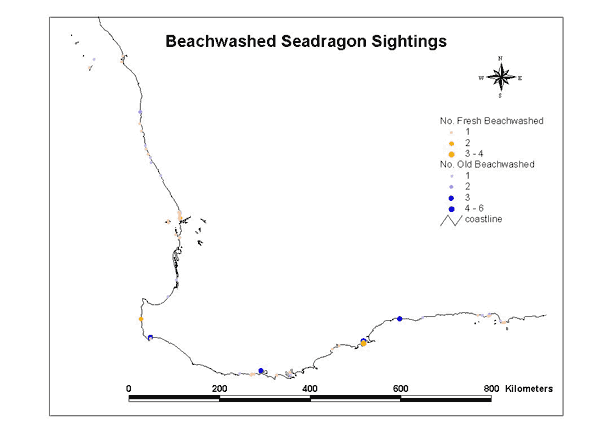
Figure 6 Distribution
of beachwashed seadragon sightings, to September 2000
Other Data (Depth of Sightings; Water Temperature)
To date, the recorded range of weedy sightings reported by divers has
been 2m to 36m, with 81% of those sightings being from waters 4m to 10m.
To September 2000, the two deepest depths at which weedies have been recorded
during Dragon Search are (i) 36m, from a steep “rock wall” dive site at
Esperance, during December 1999, and (ii) 25m, at a granite reef dive site,
also in Esperance (Lucky Bay), where the weedy was apparently recorded
drifting in kelp. To date, Dragon Search divers have recorded leafies
at depths between 2m and 19m, with 71% of records coming from depths between
4m and 11m. To date, the deepest depth record for leafies has come from
sandy habitat at Three Rocks, in Marmion Marine Park (animal recorded at
19m, in November 1995).
The available data cannot be used to infer that seadragons are more abundant at shallow depths (i.e. less than 10m) compared with teen figure depths or those greater than 20m, due to the non-systematic nature of the recordings, which are influenced by diver preferences regarding time of year, location and depth of dive. Similarly, little can be inferred about seasonal depth variations in seadragon distribution from available data. Several reasons include the fact that
(i) the number of sightings recorded per month is opportunistic, according
to diver preferences;
(ii) the survey was not standardised: i.e. seadragons were not searched
for, at specific depths, in every month; and
(iii) the uneven numbers of records between months influences the depth
range of the sightings that are recorded in each month (e.g. for some months,
seadragons may be found at other depths that have not recorded due to the
smaller number of records available for those months).
Other influences include possible depth gauge inaccuracies on divers' watches, and the fact that in some parts of the state, sighting depths are influenced by the depth of features at preferred dive locations, such as depth of reef patch/“bommie”/rock wall etc. That is, sea dragons may be found at other depths in the vicinity, but such depths were not surveyed because they did not contain the feature of dive interest.
Similar caveats apply to the interpretation of temperature recorded
during seadragon sightings, particularly due to the prevalence of summer
diving (i.e. pleasant diving conditions), and the under-representation
of winter sightings. Recorded temperature range for sightings has ranged,
to date, from 14oC to 25oC for weedies, and 16oC
to 25oC for leafies. Note that there has also been 1 record
of a sighting of two leafies in water of 28oC (unconfirmed
record from Roebuck Bay, Broome, in the north of W.A.). Within the depth
range range, 79% of weedy sightings and 82% of leafy sightings for which
temperature was recorded, were made in waters between 18oC and
22oC.
Seahorse and Pipefish Sightings
Pipefish and seahorses were reported in 16 sightings. The majority
of records for which pipefish have been specified under “Other Fish” have
come from Bremer Bay, in the Albury - Esperance area (WSC Bioregion), although
records of pipefish have come from two other bioregions (LNE, CWC). Sightings
of single animals, as well as a group of 12 pipefish, have been reported
from the Albany area. Records from Bremer Bay and Albany also include “mass”
sightings (e.g. “20+”; “lots”) of dead pipefish on the beach during December
1999 and January 2000. Breeding pipefish have been recorded from Bremer
Bay in December 1999, and juveniles were observed in that location in March
2000. Western seahorses have been recorded in the Albany area (e.g. 36
seahorses caught in fishing net, and released alive). In the LNE Bioregion,
pipefish and seahorses have been recorded from the Busselton jetty, and
from locations around Fremantle (e.g. sawtooth pipefish at South Mole).
In the CWC Bioregion, one Dragon Search recorder reported pipefish in the
Geraldton area.
Historical Records (pre - Dragon Search)
The Western Australian Museum has provided 182 additional historical
records to Dragon Search. These records describe an assortment of leafy
and weedy seadragon sightings in Western Australia, recorded between 1931
and 1992, as well as the following:
(i) 3 records of an unknown number of weedy seadragons sighted from
South Australia (1 record from Fowlers Bay, from 1931, and 2 from the “Eyre”
region, 1931 and undated);
(ii) 5 records of sightings of single weedy seadragons, from sites
in New South Wales (Wollongong; Long Bay; Sydney), at dates unknown
(iii) 1 record of a weedy seadragon recorded at Port Arthur, Tasmania,
in February 1982.
The following summarises historical records of note from Western Australia according to location (from north to south):
(i) Geraldton: 3 weedy sightings, recorded between 1935 and 1947;
(ii) Yanchep Beach: 1 leafy sighting, from 1968;
(iii) Hillary’s Boat Harbour: 25 sightings of leafy seadragons,
recorded between 1990 and 1993;
(iv) Waterman: 4 weedy records (1932 - 1942);
(v) North Beach: 2 records of leafies (not dated);
9 sightings of weedies, recorded between 1932 and 1952;
(vi) Scarborough: 13 sightings of weedies (1934 - 1952);
(vii) Wembley: 3 weedy sightings (1 from 1939, and 2 from 1955);
(viii) City Beach: 10 sightings of weedies (1932 - 1951);
(ix) Cottesloe: 1 leafy sighting (number of animals not
specified), and 33 records of weedies (mostly undated), although the number
of weedies per sighting was mostly not specified.
(x) Rottnest Island: 2 records of leafies (one in 1934, one
date unknown), and 1 record of a weedy sighting (1931);
(xi) Leighton / Fremantle area: 1 leafy seadragon recorded from
North Fremantle (date unknown); 6 records of sightings of single weedy
seadragons, from the Leighton Beach area (1 record reported in 1932; 3
records from August 1954; 1 record from September 1955, and 1 of unknown
date); 8 records of weedies from the Fremantle area (1 from 1935; 1 from
1940; 2 from November 1952, and the rest of unknown date);
(xii) Carnac Island and Garden Island: 1 weedy sighting at Carnac
Island (1932) and 3 weedy sightings at Garden Island (1 from 1956, and
2 from 1972);
(xiii) Bunbury: 5 weedy sightings (including 2 from 1931);
(xiv) Flinders Bay: 2 weedy sightings (1 from 1933);
(xv) Albany: 15 weedy sightings recorded between 1939 and 1964,
and 1 sighting from 1988;
(xvi) Michaelmas Island: 4 weedy sightings (from 1959);
(xvii) Esperance: 2 leafy sightings (1973 and 1986), and 3 weedy
sightings (1931, 1957, 1986).
© Copyright Dragon Search 2000
Return to Dragon Search Analysis / Reports of Dragon Search Database